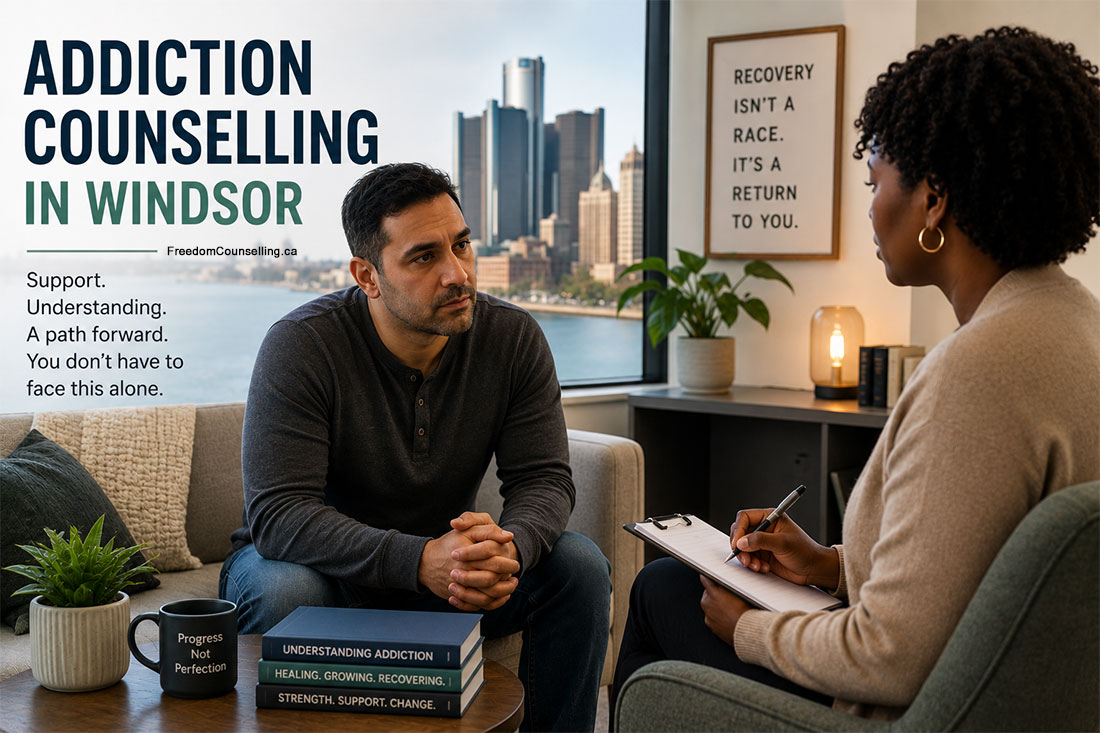
Addiction counselling in Windsor and help individuals overcome addiction, which can make life feel smaller over time.
It can affect your health.
Your relationships.
Your work.
Your finances.
Your confidence.
Your sleep.
And your ability to feel in control.
For many people, addiction does not begin as a plan to lose control.
It may begin as a way to cope with stress, anxiety, trauma, depression, grief, loneliness, or pressure.
Then slowly, the pattern becomes harder to stop.
Addiction counselling in Windsor helps by providing substance abuse therapy that gives people a private, supportive place to understand what is happening, reduce harmful patterns, and build a realistic path forward.
You do not need to have everything figured out before starting.
You only need to be willing to take the next step.
Quick Answer
Addiction recovery counselling helps by giving people support, structure, and practical tools for understanding and changing substance use or addictive behaviour.
A counsellor can help you identify triggers, manage cravings, reduce shame, build healthier coping strategies, prevent relapse, and address emotional concerns connected to addiction.
This may include support for alcohol use, drug use, prescription medication misuse, gambling, compulsive behaviours, or substance use connected to anxiety, depression, trauma, anger, or relationship stress.
CAMH describes addiction as involving craving and ongoing use despite potential harms, and notes that substances with addictive potential affect the brain’s reward system.
Addiction Counselling Helps You Understand the Pattern
Many people focus only on the behaviour.
How often am I using?
How much am I using?
Why can’t I just stop?
Those questions matter.
But counselling also looks at the pattern around the behaviour.
That can include:
- What happens before the urge appears
- What emotions make use more likely
- What situations feel hardest to handle
- What you are trying to escape, numb, or manage
- What happens after using
- What keeps the cycle going
- What support may be missing
Addiction counselling in Windsor can help you slow the pattern down and understand it more clearly.
That clarity can make change feel less impossible.
What Addiction Counselling Can Help With
Addiction counselling is not only for one type of substance or one type of person.
It can support people at different stages of concern, change, recovery, and relapse prevention.
| Concern | What It May Feel Like | How Counselling Can Help |
|---|---|---|
| Alcohol use | Drinking feels frequent, necessary, or hard to control | Identify triggers and build healthier coping strategies |
| Drug use | Cravings, secrecy, emotional reliance, or repeated setbacks | Create a recovery plan and reduce high-risk patterns |
| Prescription medication misuse | Taking more than intended or relying on medication emotionally | Explore safer coping options and support needs |
| Cannabis use | Using to relax, sleep, escape stress, or manage emotions | Understand habits and develop healthier routines |
| Gambling or compulsive behaviour | Financial stress, secrecy, guilt, or loss of control | Build accountability and interrupt urges |
| Relapse concerns | Fear of repeating old patterns | Strengthen prevention strategies and support systems |
| Family conflict | Broken trust, arguments, or emotional distance | Improve communication, boundaries, and repair |
The goal is not to judge the person.
The goal is to understand what needs to change and what support can make that change more realistic.
It Helps You Identify Triggers
A trigger is anything that increases the urge to use a substance or return to an addictive behaviour.
Triggers can be obvious.
They can also be subtle.
Common triggers include:
✓ Stress at work
✓ Conflict with a partner or family member
✓ Loneliness or isolation
✓ Anxiety or panic
✓ Depression or low mood
✓ Boredom
✓ Certain friends or social settings
✓ Paydays or weekends
✓ Grief or painful memories
✓ Feeling criticized, rejected, or ashamed
✓ Trauma reminders
✓ Exhaustion or lack of sleep
Counselling helps you recognize these triggers earlier.
That matters because the earlier you notice the pattern, the more options you have.
You can pause.
Reach out.
Use a coping tool.
Change the environment.
Delay the urge.
Or choose a safer response.
It Helps With Cravings
Cravings can feel powerful.
They can make a person feel like they have no choice.
But cravings often rise, peak, and pass.
Addiction counselling can help you build strategies for getting through that window without acting automatically.
| Craving Strategy | How It Can Help |
|---|---|
| Delay the decision | Gives the urge time to reduce in intensity |
| Change location | Breaks the immediate pattern connected to use |
| Grounding tools | Helps calm the body and nervous system |
| Call or message support | Reduces isolation during high-risk moments |
| Identify the emotion | Helps separate the urge from the feeling underneath |
| Use a replacement action | Gives the brain and body another response |
| Review consequences | Reconnects you with your recovery goals |
| Create a written plan | Makes decisions easier when cravings are strong |
Cravings do not mean failure.
They are a signal that support, structure, or coping tools are needed in that moment.
It Reduces Shame
Shame can keep addiction going.
A person may feel embarrassed, guilty, or afraid to be honest.
They may hide what is happening.
They may avoid asking for help.
They may believe they are the problem instead of recognizing that they are stuck in a pattern that needs support.
Counselling gives people a confidential place to speak honestly.
That can reduce isolation.
It can also help separate identity from behaviour.
You are not only your addiction.
You are a person trying to understand what happened, what is driving the pattern, and what needs to change next.
It Helps You Build a Realistic Recovery Plan
A recovery plan should fit real life.
It should consider your work, relationships, mental health, stress, routines, responsibilities, and level of support.
Some people want to stop completely.
Others are first trying to reduce use.
Some are returning to counselling after relapse.
Others are just beginning to admit that something needs to change.
| Recovery Goal | What Counselling May Focus On |
|---|---|
| Reducing use | Tracking patterns, setting limits, and building accountability |
| Stopping use | Creating structure, support, and relapse-prevention tools |
| Managing cravings | Practising coping tools before high-risk situations |
| Rebuilding trust | Improving honesty, communication, and repair in relationships |
| Improving mental health | Addressing anxiety, depression, trauma, or anger |
| Preventing relapse | Planning for triggers, setbacks, and stressful periods |
| Creating stability | Building healthier routines around sleep, work, food, and support |
The right plan is not the most dramatic plan.
It is the plan you can actually follow.
It Helps Address Anxiety, Depression, Trauma, and Anger
Addiction often connects to emotional pain.
Someone may use substances to feel calmer.
Someone may drink to avoid anxiety.
Someone may use drugs to numb trauma.
Someone may gamble to escape stress.
Someone may become angry or defensive because they feel ashamed or out of control.
Counselling can help address the addiction and the emotional concerns connected to it.
That may include:
✓ Anxiety and panic
✓ Depression and low mood
✓ Trauma and PTSD symptoms
✓ Anger and irritability
✓ Relationship stress
✓ Separation or divorce
✓ Grief and loss
✓ Low self-worth
✓ Shame and guilt
When the underlying emotional pressure is ignored, change can be harder to sustain.
When it is addressed, recovery may become more stable.
It Helps You Prepare for High-Risk Situations
Recovery is often tested during stressful moments.
A bad day.
A conflict.
A celebration.
A lonely weekend.
A triggering conversation.
An unexpected bill.
A memory that comes up suddenly.
Addiction counselling helps you prepare for these moments before they happen.
| High-Risk Situation | Possible Counselling Strategy |
|---|---|
| Weekend cravings | Plan structured activities and support check-ins |
| Social pressure | Practise refusal statements and exit plans |
| Conflict at home | Use time-outs, grounding, and communication tools |
| Work stress | Build healthier decompression routines |
| Loneliness | Create connection plans before isolation builds |
| Shame after setback | Review the pattern without self-attack |
| Trauma triggers | Use grounding tools and trauma-informed coping skills |
| Access to substances | Reduce availability and create barriers where possible |
Preparation does not remove every risk.
But it gives you more choices when risk appears.
It Helps After Relapse
Relapse can feel discouraging.
It can bring guilt, fear, frustration, and hopelessness.
But a relapse does not erase progress.
It can provide information.
A counsellor may help you look at:
- What happened before the relapse
- What emotion or situation made use more likely
- What support was missing
- What boundary broke down
- What warning signs appeared earlier
- What can be adjusted in the recovery plan
The goal is not to shame you.
The goal is to learn from the setback and strengthen the next step.
A Simple Addiction Counselling Check-In
This is not a diagnosis.
It is a private way to consider whether addiction counselling in Windsor may help.
| Area | Ask Yourself |
|---|---|
| Control | Do I use more often or for longer than I intended? |
| Cravings | Do I regularly feel strong urges to use? |
| Impact | Has use affected work, relationships, finances, or health? |
| Secrecy | Do I hide, minimize, or lie about my use? |
| Emotions | Do I use to cope with stress, anxiety, sadness, anger, or shame? |
| Attempts to change | Have I tried to stop or cut back but struggled to maintain it? |
| Consequences | Do I keep using even when it causes problems? |
| Support | Do I feel alone or unsure where to begin? |
You do not need to answer yes to every question.
Even one repeated pattern may be enough reason to seek support.
Counselling Is Different From Willpower
Many people blame themselves for not having enough willpower.
But addiction is rarely solved by willpower alone.
Willpower may help in the moment.
But long-term change usually needs support, structure, emotional tools, and a plan for triggers.
Counselling can help you build that structure.
It can help you move from:
“I should just stop.”
To:
“I understand my pattern, I know my triggers, I have tools, and I know what to do next.”
That is a very different position to be in.
What About Family and Relationship Support?
Addiction often affects more than one person.
Partners, parents, children, siblings, and close friends may feel hurt, confused, angry, or unsure how to help.
Counselling may support relationship repair by helping people work on:
- Honesty
- Communication
- Boundaries
- Accountability
- Emotional regulation
- Trust rebuilding
- Managing conflict
- Understanding the impact of addiction
Repair takes time.
It also requires consistent behaviour, not just promises.
A counsellor can help make that process clearer and more realistic.
When Medical or Crisis Support May Be Needed
Counselling can be an important part of addiction recovery.
But some situations may also require medical or urgent support.
Withdrawal from some substances can be serious or dangerous.
If you are worried about withdrawal, overdose risk, severe symptoms, or immediate safety, seek medical care or urgent help.
ConnexOntario provides free, confidential information and help finding mental health, gambling, drug, and alcohol services in Ontario.
If you are in immediate danger or need urgent medical support, call 9-1-1.
If you are thinking about suicide or worried about someone else, call or text 9-8-8 in Canada for 24/7 crisis support.
Finding Addiction Counselling in Windsor
The right counsellor should make you feel respected, supported, and able to be honest.
You should not feel judged for where you are starting.
When looking for addiction counselling in Windsor, consider asking:
- Do you support addiction recovery and substance use concerns?
- Can you help with alcohol, drug use, gambling, or compulsive behaviour?
- Do you support both harm reduction and abstinence goals?
- Can you help with anxiety, depression, trauma, or anger connected to addiction?
- What happens if I relapse?
- Do you offer secure virtual counselling for Windsor residents?
You do not need the perfect plan before reaching out.
You can begin with a simple statement:
“I think I need help changing this pattern.”
That is enough.
Final Thoughts
Addiction counselling helps by turning confusion into clarity.
It helps people understand what is driving the pattern.
It helps build tools for cravings, stress, triggers, relapse prevention, and emotional recovery.
It also helps people feel less alone.
Addiction counselling in Windsor can support people who are ready to stop, trying to reduce use, recovering after relapse, or simply beginning to question whether their current pattern is working.
Freedom Counselling provides supportive counselling for people navigating addiction recovery, substance abuse concerns, anxiety, depression, trauma, anger, domestic violence concerns, separation, divorce, and other difficult life experiences.
Frequently Asked Questions About Addiction Counselling in Windsor
How does addiction counselling help?
Addiction counselling helps people understand substance use or addictive behaviour, identify triggers, manage cravings, reduce shame, build coping tools, and create a realistic plan for recovery or change.
Do I need to stop using before starting addiction counselling?
No. Many people begin counselling while they are still using or while they are trying to reduce their use. A counsellor can help you explore goals that fit your current situation.
Can addiction counselling help with alcohol use?
Yes. Addiction counselling can help people who are concerned about alcohol use, cravings, repeated drinking patterns, relationship problems, or difficulty cutting back.
Can addiction counselling help after relapse?
Yes. A relapse does not mean that progress is lost. Counselling can help you understand what contributed to the relapse and adjust your recovery plan moving forward.
Is online addiction counselling available in Windsor?
Many Ontario counsellors offer secure virtual counselling. Online addiction counselling can be helpful for Windsor residents who prefer privacy, flexibility, or support from home.