
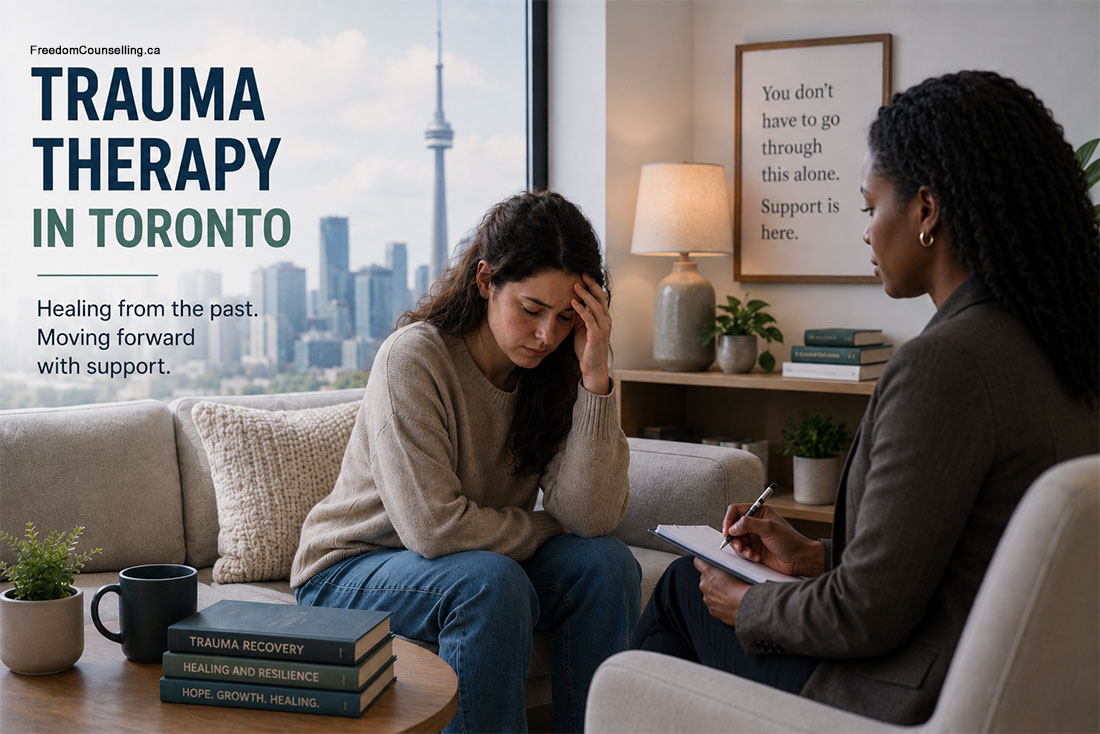
Trauma therapy in Toronto can help individuals that have experienced trauma, which can affect people long after the event or experience has ended.
Sometimes the impact is obvious.
Other times, it shows up in ways that feel confusing.
Anxiety.
Panic.
Sleep problems.
Anger.
Emotional numbness.
Relationship struggles.
Feeling constantly on edge.
Avoiding certain places, conversations, or memories.
Trauma therapy in Toronto can help people understand how a difficult experience is affecting their daily life and begin moving forward in a safer, more supported way.
You do not need to have a PTSD diagnosis before seeking help.
You also do not need to share every detail right away.
A trauma-informed therapist should help you move at a pace that feels manageable.
Quick Answer
Yes, trauma therapy can help after trauma.
It can help people process difficult experiences, reduce emotional distress, understand triggers, build coping tools, and feel more grounded in daily life.
Trauma therapy is not about forcing someone to relive the past.
It is about helping the brain and body feel safer in the present.
For some people, trauma therapy may focus on PTSD symptoms.
For others, it may focus on anxiety, depression, anger, relationship patterns, trust issues, grief, addiction recovery, or emotional overwhelm connected to past experiences.
CAMH notes that trauma counselling or therapy can be helpful for people with PTSD, and that therapy should be adapted to the needs of each client.
What Counts as Trauma?
Trauma is not limited to one type of event.
It can come from a single experience.
It can also come from repeated stress, abuse, neglect, loss, fear, or instability over time.
Trauma may be connected to:
✓ A car accident or serious injury
✓ Domestic violence or relationship abuse
✓ Childhood neglect or abuse
✓ Sexual assault or harassment
✓ Sudden loss or grief
✓ Workplace trauma or bullying
✓ Medical trauma
✓ Community violence
✓ Emotional abuse or coercive control
✓ Addiction-related experiences
✓ Separation, divorce, or family conflict
✓ Long-term stress where someone felt unsafe or powerless
The Government of Canada describes trauma as emotional, psychological, or physical responses to extremely stressful events, and notes that PTSD can develop after experiencing, witnessing, or learning about traumatic events.
You do not need to compare your experience to someone else’s.
If something has continued to affect your nervous system, relationships, emotions, or sense of safety, it is worth taking seriously.
When Trauma Therapy in Toronto May Help
Trauma can show up in daily life even when you are trying to move forward.
You may look fine on the outside while feeling unsettled inside.
You may keep busy to avoid thinking.
You may feel disconnected from yourself or other people.
You may benefit from trauma counselling in Toronto if you notice:
| Sign | What It May Feel Like |
|---|---|
| Hypervigilance | Feeling alert, tense, or unsafe even when nothing obvious is wrong |
| Avoidance | Avoiding places, people, conversations, or memories connected to trauma |
| Intrusive memories | Unwanted thoughts, images, nightmares, or emotional flashbacks |
| Anxiety or panic | Sudden fear, racing thoughts, tight chest, or feeling overwhelmed |
| Emotional numbness | Feeling detached, shut down, or unable to connect emotionally |
| Anger or irritability | Reacting strongly or feeling easily triggered |
| Trust issues | Difficulty feeling safe in relationships |
| Sleep problems | Trouble falling asleep, staying asleep, or feeling rested |
| Shame or guilt | Blaming yourself or feeling responsible for what happened |
| Depression | Low mood, hopelessness, loss of interest, or withdrawal |
One symptom can be enough reason to seek support.
You do not need to wait until trauma affects every part of your life.
What Happens in Trauma Therapy?
Trauma therapy usually begins with safety, trust, and stabilization.
This matters.
If someone feels overwhelmed too quickly, therapy can become harder instead of more helpful.
A trauma therapist may begin by helping you understand:
- What triggers your trauma responses
- What happens in your body when you feel unsafe
- How trauma may affect sleep, mood, anger, or relationships
- What coping tools can help you feel grounded
- What boundaries or supports may help you feel safer
- What goals feel realistic for therapy
CAMH’s PTSD treatment guidance notes that treatment should be individualized and that physical and emotional safety are important early priorities.
This means therapy does not have to begin with the most painful details.
It can begin with what is happening today.
Trauma Therapy Is Not About Being Forced to Talk
Many people worry that trauma therapy means they will have to explain everything immediately.
That fear is understandable.
But good trauma therapy should not feel like pressure.
You can say:
- “I am not ready to talk about that yet.”
- “I need to slow down.”
- “Can we focus on coping tools first?”
- “I want help with anxiety before discussing the details.”
- “I need a break.”
Therapy should help you build more control.
Not less.
For many people, the first stage of trauma therapy is simply learning how to feel steadier in daily life.
What Trauma Therapy Can Help With
Trauma therapy can support different goals depending on the person.
Some people want to reduce panic.
Some want to stop avoiding certain situations.
Some want to feel less angry.
Some want to rebuild trust after an abusive relationship.
Some want to understand why they feel numb, disconnected, or constantly alert.
| Therapy Goal | What It May Involve |
|---|---|
| Feeling safer | Grounding tools, emotional regulation, and body awareness |
| Reducing triggers | Understanding what activates fear, panic, anger, or shutdown |
| Improving sleep | Addressing nightmares, tension, and nighttime anxiety |
| Managing anxiety | Learning strategies for worry, panic, and hypervigilance |
| Processing memories | Working through difficult experiences at a safe pace |
| Rebuilding trust | Exploring boundaries, attachment, and relationship patterns |
| Reducing shame | Challenging self-blame and understanding trauma responses |
| Moving forward | Creating routines, goals, and healthier coping strategies |
Progress may be gradual.
But even small changes can matter.
Sleeping better.
Feeling calmer after a trigger.
Having one difficult conversation without shutting down.
Recognizing that your reactions make sense.
These are signs of movement.
A Simple Trauma Check-In
This is not a diagnosis.
It is a private way to consider whether trauma therapy in Toronto may be helpful.
| Area | Ask Yourself |
|---|---|
| Safety | Do I often feel tense, alert, or unsafe even when I am not in danger? |
| Avoidance | Do I avoid reminders, conversations, places, or people connected to the experience? |
| Mood | Do I feel numb, sad, angry, ashamed, or disconnected more often than I want to? |
| Body | Do I experience panic, tightness, nausea, shaking, or racing thoughts? |
| Sleep | Do I struggle with nightmares, insomnia, or waking up anxious? |
| Relationships | Has trauma affected trust, closeness, boundaries, or communication? |
| Control | Do my reactions feel bigger or faster than I can manage? |
| Daily life | Is the past affecting my work, family, parenting, school, or routines? |
If several of these feel familiar, therapy may help.
You do not need to know exactly what type of trauma support you need before starting.
Trauma and PTSD Are Related, But Not the Same
A trauma therapist can help people with PTSD.
It can also help people who do not meet the full criteria for PTSD.
PTSD may include symptoms such as intrusive memories, avoidance, negative changes in mood or beliefs, and feeling constantly on guard after trauma.
But many people experience trauma-related struggles without using the word PTSD.
They may feel anxious.
They may become irritable.
They may withdraw.
They may struggle with intimacy, trust, or emotional regulation.
They may feel stuck in survival mode.
Trauma therapy can still be useful.
The goal is not to chase a label.
The goal is to understand what is happening and get support that fits.
Common Trauma Therapy Approaches
Different Toronto therapists use different approaches.
Some people benefit from structured techniques.
Others need a slower, more relational approach.
Some need practical tools first.
Others may be ready for deeper processing.
Common trauma therapy approaches may include:
- Cognitive behavioural therapy
- EMDR therapy
- Trauma-informed counselling
- Somatic or body-based therapy
- Mindfulness and grounding strategies
- Psychodynamic therapy
- Sensorimotor therapy
- Emotion-focused therapy
- Attachment-focused therapy
CAMH lists approaches such as cognitive-behavioural therapy, psychodynamic therapy, sensorimotor therapy, and eye movement desensitization and reprocessing among common trauma therapy options.
The right approach depends on your needs, goals, comfort level, and history.
Can Trauma Therapy Help With Anxiety?
Yes.
Anxiety is one of the most common ways trauma can show up.
After trauma, the nervous system may become more sensitive to danger.
Even safe situations may start to feel threatening.
This can lead to:
✓ Panic attacks
✓ Overthinking
✓ Avoidance
✓ Trouble relaxing
✓ Fear of conflict
✓ Social anxiety
✓ Health anxiety
✓ Driving anxiety
✓ Feeling constantly on edge
Trauma therapy can help you notice when anxiety is connected to old danger signals rather than the present moment.
That awareness can make anxiety easier to manage.
Can Trauma Therapy Help With Relationships?
Yes.
Trauma can affect how people trust, communicate, set boundaries, and respond to closeness.
Some people become guarded.
Some become anxious in relationships.
Some shut down during conflict.
Some feel responsible for keeping everyone else calm.
Others become angry quickly because their nervous system is already under stress.
Trauma therapy may help you understand:
- Why certain relationship patterns repeat
- How to set safer boundaries
- What triggers shutdown, panic, or anger
- How to communicate needs more clearly
- How to rebuild trust gradually
- How to recognize healthy and unhealthy relationship dynamics
Healing does not mean trusting everyone.
It means learning how to trust yourself again.
Can Trauma Therapy Help After Domestic Violence?
Yes, trauma therapy can support people after domestic violence or relationship abuse.
However, safety comes first.
If there is current danger, threats, stalking, coercive control, or violence, therapy may need to be combined with specialized domestic violence supports, legal guidance, shelter services, or crisis resources.
A trauma counsellor can help with emotional recovery, but counselling is not an emergency service.
If you are in immediate danger, call 9-1-1.
What Progress Can Look Like After Trauma
Healing from trauma is not always dramatic.
Sometimes progress is quiet.
It may look like:
- Sleeping through the night more often
- Feeling less tense in your body
- Understanding your triggers sooner
- Having fewer panic symptoms
- Feeling more present in conversations
- Setting one healthier boundary
- Feeling less shame about your reactions
- Reconnecting with people you trust
- Feeling more control during conflict
- Believing that the future can be different
Progress does not mean forgetting what happened.
It means the past has less power over your present.
When Trauma May Need Urgent Support
Trauma therapy can be helpful.
But it is not an emergency service.
If you are in immediate danger or need urgent medical support, call 9-1-1.
If you are thinking about suicide or worried about someone else, call or text 9-8-8 in Canada for 24/7 crisis support.
You deserve support before things feel unmanageable.
Finding a Trauma Therapist in Toronto
The right trauma therapist should help you feel respected, safe, and in control of the pace.
You should not feel judged, rushed, or pressured.
When looking for trauma therapy in Toronto, consider asking:
- Do you have experience supporting trauma and PTSD symptoms?
- How do you help clients feel safe during sessions?
- What trauma therapy approaches do you use?
- Can we begin with coping tools before discussing details?
- Can you help with anxiety, depression, anger, or relationship stress connected to trauma?
- Do you offer secure virtual counselling for Toronto residents?
You do not need to find perfect words before reaching out.
You can begin with: “Something happened, and I do not feel like myself.”
That is enough to start.
Final Thoughts
Trauma can make the past feel present.
It can affect your body, thoughts, emotions, relationships, and sense of safety.
But trauma does not have to define your future.
Trauma therapy in Toronto can help you understand what you are carrying, build practical coping tools, and begin moving forward at a pace that feels safe.
Freedom Counselling provides supportive counselling for people navigating trauma, anxiety, depression, anger, addiction recovery, domestic violence concerns, separation, divorce, and other difficult life experiences.
Frequently Asked Questions About Trauma Therapy in Toronto
Can trauma therapy help after trauma?
Yes. Trauma therapy can help people understand triggers, reduce distress, build coping tools, process difficult experiences, and feel safer in daily life after trauma.
Do I need PTSD to start trauma therapy?
No. You do not need a PTSD diagnosis to start trauma therapy. Many people seek support for anxiety, sleep problems, anger, emotional numbness, relationship struggles, or stress connected to past experiences.
Will I have to talk about everything that happened?
No. A trauma-informed therapist should help you move at a manageable pace. You can begin with current symptoms, coping tools, and emotional safety before discussing painful details.
Can trauma therapy help with anxiety and panic?
Yes. Trauma therapy can help people understand how anxiety and panic may be connected to past experiences, triggers, or nervous-system responses. Therapy can also teach grounding and calming strategies.
Is online trauma therapy available in Toronto?
Many Ontario counsellors offer secure virtual sessions. Online trauma therapy can be helpful for Toronto residents who prefer privacy, flexibility, or support from home.