
Bipolar disorder therapy in Toronto helps individuals dealing with bipolar disorder, which can affect much more than mood.
It can affect sleep.
Energy.
Thinking.
Relationships.
Work.
Finances.
Confidence.
And the ability to feel steady in daily life.
Some people experience periods of depression where life feels heavy, slow, hopeless, or emotionally flat.
Others experience periods of elevated mood, increased energy, racing thoughts, impulsive decisions, irritability, or feeling like they need very little sleep.
Bipolar disorder therapy in Toronto can help people understand these patterns, build stability, strengthen coping tools, and support long-term wellness alongside appropriate medical care.
You do not need to manage these changes alone.
You also do not need to wait until things feel out of control before asking for support.
Quick Answer
Bipolar disorder therapy can help by supporting mood awareness, emotional regulation, routine building, stress management, relationship communication, relapse prevention, and coping skills for depressive, manic, or hypomanic symptoms.
Therapy is not usually a replacement for medical care or medication support. CAMH identifies medication and psychotherapy as the main treatment options for bipolar disorder, and also notes that medication is generally considered a cornerstone of treatment.
A therapist can work with you to better understand mood patterns, reduce shame, improve daily structure, and create plans for early warning signs before symptoms escalate.
What Is Bipolar Disorder?
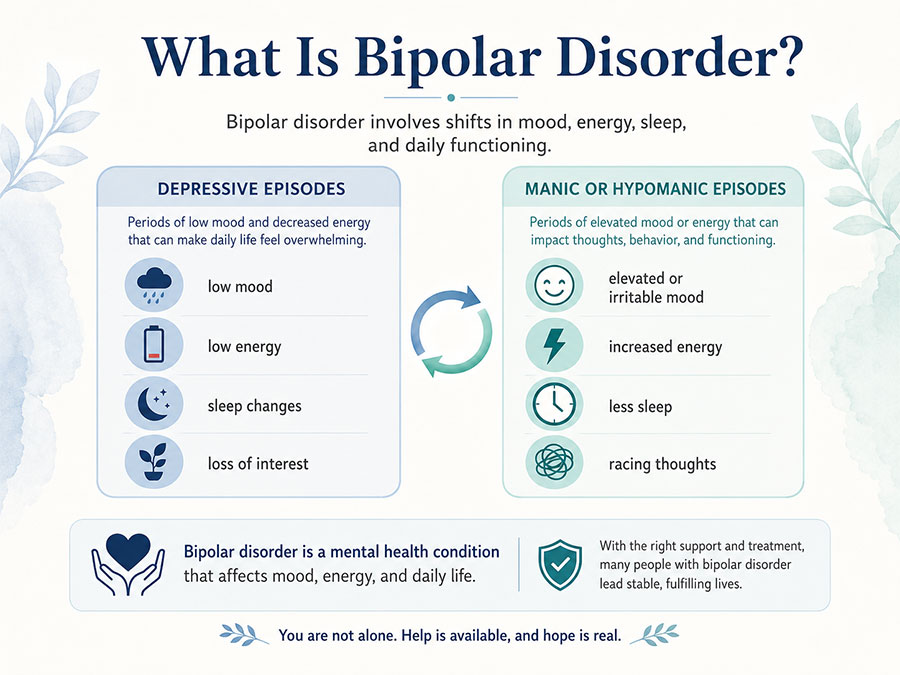
Bipolar disorder is a mental-health condition that involves changes in mood, energy, activity, sleep, and functioning.
These mood changes may include depressive episodes, manic episodes, or hypomanic episodes.
Depression may feel like low mood, low energy, loss of interest, hopelessness, withdrawal, sleep changes, or difficulty functioning.
Mania or hypomania may involve unusually elevated or irritable mood, increased energy, racing thoughts, decreased need for sleep, impulsivity, increased activity, or behaviour that feels out of character.
CAMH explains that symptoms of bipolar disorder affect mood, thinking, behaviour, and functioning.
Bipolar disorder is not a personal failure.
It is a condition that deserves informed, compassionate, consistent support.
Bipolar Disorder Therapy vs. Medication Support
Bipolar disorder often requires more than one type of care.
A therapist can help with coping strategies, emotional awareness, routines, relationships, and relapse prevention.
A physician, psychiatrist, or qualified prescriber is usually involved when medication assessment or medication management is needed.
| Type of Support | Main Focus |
|---|---|
| Therapy or counselling | Coping tools, routines, mood awareness, stress management, relationships, and relapse prevention |
| Medication support | Mood stabilization, symptom management, and medical monitoring |
| Psychiatric assessment | Diagnosis, medication planning, and complex symptom review |
| Family support | Education, communication, boundaries, and support planning |
| Crisis support | Immediate help during severe symptoms, safety risks, or urgent distress |
CAMH states that there are no laboratory tests for bipolar disorder, but medical tests may be used to rule out other illnesses with similar symptoms, such as thyroid disease.
That is why proper assessment matters.
Therapy can support daily functioning, but diagnosis and medication questions should be handled by qualified health-care professionals.
How Therapy Can Help With Bipolar Disorder
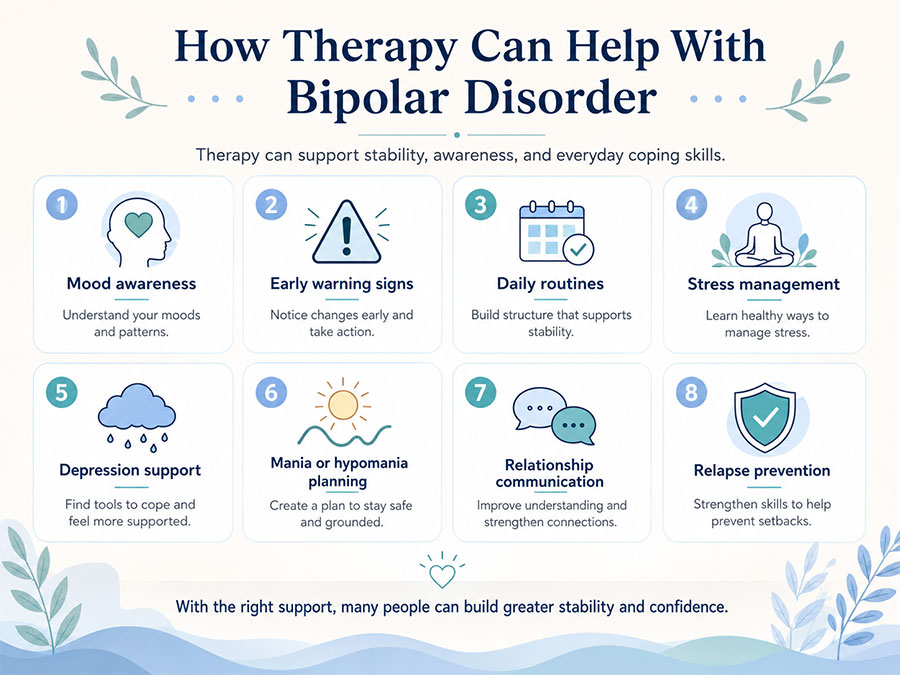
Therapy can help people understand what makes symptoms better or worse.
It can also help create practical systems for staying more stable over time.
| Area of Support | How Therapy May Help |
|---|---|
| Mood awareness | Track changes in energy, sleep, thoughts, and behaviour |
| Early warning signs | Notice shifts before symptoms become more intense |
| Routines | Build consistent sleep, meals, work, rest, and support habits |
| Stress management | Reduce stressors that may contribute to mood instability |
| Communication | Help partners, family, or friends understand what support looks like |
| Depression support | Build coping tools for low mood, hopelessness, withdrawal, and fatigue |
| Mania or hypomania support | Create plans around impulsivity, sleep disruption, irritability, or escalation |
| Shame reduction | Separate identity from symptoms and past episodes |
| Relapse prevention | Build a plan for what to do when warning signs appear |
Therapy helps make patterns more visible.
When patterns become more visible, they can become easier to manage.
What Happens in the First Bipolar Disorder Therapy Session?
The first session is usually focused on understanding your history, current symptoms, and goals.
You do not need to explain everything perfectly.
You can begin with what has been most difficult lately.
A therapist may ask about:
- Mood changes you have noticed
- Periods of depression, elevated mood, irritability, or increased energy
- Sleep patterns and changes in energy
- Racing thoughts, impulsive behaviour, or risky decisions
- Anxiety, trauma, addiction, anger, or relationship stress
- Current medication or medical supports, if applicable
- Past diagnoses or assessments
- What you want therapy to help with
The goal is not to judge you.
The goal is to understand what support may be safest, most practical, and most useful.
What Helps During Depressive Episodes?
Depressive episodes can make life feel heavy and slow.
You may feel disconnected, exhausted, hopeless, guilty, or unable to enjoy things that usually matter.
Therapy may help by focusing on small, realistic steps.
| Depressive Challenge | Therapy Support |
|---|---|
| Low motivation | Break tasks into smaller, manageable steps |
| Hopeless thoughts | Identify and challenge depressive thinking patterns |
| Withdrawal | Create gentle reconnection plans |
| Fatigue | Build realistic routines without self-blame |
| Sleep disruption | Strengthen sleep habits and reduce nighttime stress |
| Shame | Separate symptoms from identity |
| Loss of interest | Reintroduce meaningful activities gradually |
| Relationship strain | Communicate what support is helpful |
Therapy should not simply tell you to “try harder.”
It should help you create steps that are possible when your energy is low.
What Helps During Mania or Hypomania?
Mania and hypomania can feel different for different people.
For some, they may feel exciting or productive at first.
For others, they may feel agitated, restless, irritable, impulsive, or overwhelming.
Therapy can help you identify early warning signs and create a plan before symptoms escalate.
| Possible Warning Sign | Therapy Planning May Include |
|---|---|
| Sleeping much less | Create a sleep-protection plan and involve medical support when needed |
| Racing thoughts | Use grounding, pacing, and external support |
| Increased spending | Set financial safeguards or accountability steps |
| Impulsive decisions | Delay major choices and discuss them with trusted supports |
| Irritability | Practise pause skills and reduce conflict triggers |
| Increased activity | Monitor workload, commitments, and overstimulation |
| Feeling unusually confident or invincible | Review past patterns and risk indicators |
| Risk-taking behaviour | Build a safety and support plan |
Mania can become serious.
If symptoms are severe, involve psychosis, create safety risks, or make it difficult to function, medical or urgent support may be needed.
Why Mood Tracking Can Help
Mood tracking is often useful in bipolar disorder therapy because it helps connect daily patterns to mood shifts.
A therapist may encourage tracking:
✓ Mood
✓ Sleep
✓ Energy
✓ Irritability
✓ Anxiety
✓ Medication consistency, if applicable
✓ Substance use
✓ Stress levels
✓ Workload
✓ Social activity
✓ Major triggers
✓ Early warning signs
Mood tracking does not need to be complicated.
Even a simple daily note can help you see patterns that are hard to notice in the moment.
Sleep and Routine Matter
Sleep disruption can be especially important for people living with bipolar disorder.
Changes in sleep may sometimes appear before mood symptoms become more intense.
Therapy can help support routines around:
- Sleep and wake times
- Evening wind-down habits
- Workload and overstimulation
- Meals and movement
- Social commitments
- Screen use and late-night activity
- Stress management
- Recovery after busy periods
Stable routines do not solve everything.
But they can support steadier daily functioning.
Therapy Can Help With Relationships
Bipolar disorder can affect relationships, especially when mood episodes create confusion, conflict, withdrawal, impulsive choices, or broken trust.
Therapy may help with:
- Explaining symptoms to loved ones
- Repairing after conflict
- Setting boundaries during mood episodes
- Creating support plans with partners or family
- Reducing shame after difficult periods
- Communicating needs more clearly
- Identifying what help is supportive versus controlling
- Rebuilding trust over time
Family or couples support may sometimes be helpful, but individual counselling can also be an important starting point.
Bipolar Disorder, Anxiety, Addiction, Trauma, and Anger
Bipolar disorder can overlap with other concerns.
Some people also experience anxiety, substance use, trauma symptoms, anger, grief, or relationship stress.
CAMH notes that many people with bipolar disorder have other psychiatric and medical comorbidities.
Therapy may also support concerns such as:
✓ Anxiety and panic
✓ Depression and low mood
✓ Trauma or PTSD symptoms
✓ Addiction recovery or substance use
✓ Anger and irritability
✓ Relationship stress
✓ Separation or divorce
✓ Shame and low self-worth
✓ Work or school pressure
Addressing related concerns can make the overall support plan stronger.
A Simple Bipolar Disorder Therapy Check-In
This is not a diagnosis.
It is a private way to consider whether bipolar disorder therapy in Toronto may be helpful.
| Area | Ask Yourself |
|---|---|
| Mood | Do I experience mood shifts that feel hard to manage or understand? |
| Sleep | Do changes in sleep sometimes connect with changes in mood or energy? |
| Depression | Do I have periods of low mood, fatigue, withdrawal, or hopelessness? |
| Energy | Do I have periods of increased energy, restlessness, or racing thoughts? |
| Decisions | Do I make impulsive choices during certain mood states? |
| Relationships | Have mood changes affected trust, communication, or conflict? |
| Routine | Is it difficult to maintain consistent habits during mood shifts? |
| Support | Do I need help creating a plan for early warning signs? |
If several of these feel familiar, therapy may be worth considering.
You do not need to know exactly what kind of support you need before reaching out.
What Therapy Approaches May Help?
Different therapists use different approaches depending on training, client needs, and treatment goals.
Therapy for bipolar disorder may include:
- Cognitive behavioural therapy
- Psychoeducation
- Interpersonal and social rhythm strategies
- Family-focused support
- Relapse-prevention planning
- Mindfulness and grounding tools
- Emotion regulation strategies
- Stress-management counselling
- Support for routines and daily structure
CAMH identifies psychotherapy as one of the main treatment options for bipolar disorder.
The right approach depends on your symptoms, goals, medical supports, and life circumstances.
What Therapy Cannot Do Alone
Therapy can be very helpful, but it has limits.
It should not replace medical care when bipolar symptoms require assessment, diagnosis, medication review, or urgent support.
A therapist cannot prescribe medication unless they are also a qualified prescriber.
A therapist should also not encourage someone to stop or change medication without medical guidance.
Therapy works best when it supports the larger care plan.
That may include a family doctor, psychiatrist, medication provider, crisis team, support group, or trusted family supports.
What If I Am Not Diagnosed Yet?
You can still speak with a therapist about mood concerns.
However, bipolar disorder diagnosis should be completed by an appropriate health-care professional.
A therapist can help you organize what you are experiencing, track patterns, and identify whether additional medical or psychiatric assessment may be appropriate.
It can be helpful to write down:
- Mood changes
- Sleep changes
- Energy shifts
- Impulsive or risky behaviours
- Depressive periods
- Family history, if known
- Medication history, if applicable
- Substance use
- Stressors and triggers
- How symptoms affect daily life
This information may be useful when speaking with a doctor or psychiatrist.
When Bipolar Symptoms May Need Urgent Support
Bipolar disorder therapy can be helpful, but it is not an emergency service.
Urgent support may be needed if someone is experiencing:
- Thoughts of suicide or self-harm
- Psychosis, hallucinations, or delusional beliefs
- Severe mania
- Dangerous impulsive behaviour
- Not sleeping for extended periods
- Inability to care for basic needs
- Threats, violence, or immediate safety risks
- Severe substance use or overdose risk
If there is immediate danger or urgent medical concern, call 9-1-1 or go to the nearest emergency department.
If you are thinking about suicide or worried about someone else, call or text 9-8-8 in Canada for 24/7/365 crisis support.
Is Online Bipolar Disorder Therapy Available in Toronto?
Many Ontario counsellors offer secure virtual therapy.
Online bipolar disorder therapy may be helpful for Toronto residents who want privacy, flexibility, or support from home.
Virtual counselling can support mood tracking, routines, depression coping tools, stress management, relationship communication, and relapse-prevention planning.
However, if symptoms are severe, rapidly escalating, or connected to immediate safety concerns, online counselling may need to be combined with medical or urgent support.
Finding Bipolar Disorder Therapy in Toronto
The right therapist should help you feel respected, understood, and supported.
They should also be comfortable working alongside medical care when needed.
When looking for bipolar disorder therapy in Toronto, consider asking:
- Do you have experience supporting people with bipolar disorder?
- How do you help clients track mood, sleep, energy, and early warning signs?
- Can you support depressive episodes, hypomania, mania-related concerns, or relapse prevention?
- Do you work alongside medical or psychiatric care when needed?
- Can you help with anxiety, trauma, addiction recovery, anger, or relationship stress?
- Do you offer secure virtual counselling for Toronto residents?
You do not need perfect words before reaching out.
You can begin with:
“My mood and energy change in ways that are affecting my life, and I need support.”
That is enough.
Final Thoughts
Bipolar disorder therapy in Toronto can help people better understand mood patterns, build stability, strengthen coping tools, and create practical plans for difficult periods.
Therapy may help with depression, hypomania or mania-related concerns, stress, relationships, shame, routines, and relapse prevention.
It is often most helpful when combined with appropriate medical care, especially when medication or diagnostic support is needed.
Freedom Counselling provides supportive counselling for people navigating bipolar disorder concerns, depression, anxiety, trauma, anger, addiction recovery, domestic violence concerns, separation, divorce, and other difficult life experiences.
Frequently Asked Questions About Bipolar Disorder Therapy in Toronto
What is bipolar disorder therapy?
Bipolar disorder therapy is counselling that helps people understand mood patterns, manage stress, build routines, identify early warning signs, improve communication, and create practical strategies for living with bipolar disorder.
Can therapy help with bipolar disorder?
Yes. Therapy can help with mood awareness, coping tools, depression support, stress management, routines, relationship communication, and relapse-prevention planning. It is often used alongside medical care and medication support.
Is therapy a replacement for bipolar medication?
No. Therapy is not usually a replacement for medication or medical care. Bipolar disorder often requires medical assessment and treatment planning. A therapist can support coping, routines, and emotional wellbeing as part of a broader care plan.
Can bipolar disorder therapy help during depressive episodes?
Yes. Therapy can help during depressive episodes by supporting small routines, reducing isolation, challenging hopeless thoughts, improving communication, and creating manageable steps when energy and motivation are low.
Is online bipolar disorder therapy available in Toronto?
Many Ontario counsellors offer secure virtual counselling. Online bipolar disorder therapy can be helpful for Toronto residents who want privacy, flexibility, and support from home, especially when symptoms are stable enough for outpatient counselling.