
Anxiety therapy in Oshawa can help manage anxiety symptoms and causes, which is often difficult to explain when you are living with it every day.
You may look calm on the outside while feeling tense, overwhelmed, or exhausted inside.
You may overthink conversations.
Avoid certain places.
Replay small mistakes.
Feel nervous before work, school, appointments, driving, social plans, or difficult conversations.
For some people, anxiety comes in sudden waves.
For others, it becomes a constant background pressure.
Anxiety therapy in Oshawa can help you understand what is happening, reduce avoidance, manage physical symptoms, and build practical tools for feeling more in control.
You do not need to wait until anxiety becomes severe.
If anxiety is starting to affect your sleep, relationships, work, school, parenting, confidence, or daily routines, therapy may be worth considering.
Quick Answer
Anxiety therapy may be right for you if worry, panic, fear, overthinking, physical tension, or avoidance are making everyday life harder to manage.
A therapist can help you identify anxiety triggers, understand how anxiety affects your thoughts and body, practise calming strategies, challenge fear-based thinking, and gradually build confidence in situations you may be avoiding.
CAMH explains that anxiety can involve cognitive, physical, and behavioural symptoms, and that people who suspect they may have an anxiety disorder should seek professional treatment as soon as possible.
Normal Anxiety vs. Anxiety That May Need Support
Anxiety is not always a problem.
It can be a normal reaction to stress, uncertainty, danger, pressure, or major life changes.
You might feel anxious before a job interview, exam, medical appointment, first date, performance review, or difficult conversation.
That kind of anxiety may pass once the situation is over.
Anxiety may need more attention when it becomes frequent, intense, hard to control, or starts limiting your life.
| Normal Anxiety | Anxiety That May Need Therapy |
|---|---|
| Connected to a specific stressful event | Shows up often, even when there is no clear danger |
| Eases after the situation passes | Continues for days, weeks, or longer |
| Feels uncomfortable but manageable | Feels overwhelming or hard to control |
| Does not significantly limit daily life | Leads to avoidance, panic, sleep problems, or constant worry |
| Helps you prepare or stay alert | Makes it harder to function, rest, connect, or make decisions |
CAMH’s anxiety guide focuses on the difference between normal anxiety and anxiety disorders such as panic disorder, generalized anxiety disorder, and phobias.
Signs Anxiety Therapy in Oshawa May Be Right for You
You do not need to have a diagnosis before starting therapy.
You also do not need to experience every symptom.
You may benefit from anxiety counselling in Oshawa if you notice:
✓ Constant worry that feels hard to turn off
✓ Overthinking conversations, decisions, mistakes, or future events
✓ Avoiding situations because of fear or discomfort
✓ Panic attacks or sudden waves of intense fear
✓ Trouble sleeping because your mind feels too active
✓ Feeling tense, restless, irritable, or on edge
✓ Difficulty concentrating at work, school, or home
✓ Fear of judgment, embarrassment, rejection, or failure
✓ Physical symptoms such as racing heart, nausea, shaking, tight chest, or shortness of breath
✓ Feeling emotionally drained from trying to manage anxiety every day
One recurring pattern can be enough reason to seek support.
Therapy is not only for crisis moments.
It can also help when you want to prevent anxiety from becoming more disruptive.
What Anxiety Can Look Like
Anxiety is not the same for everyone.
Some people worry constantly.
Some experience panic attacks.
Some avoid social situations.
Some feel anxious in relationships.
Some feel anxiety through physical symptoms more than thoughts.
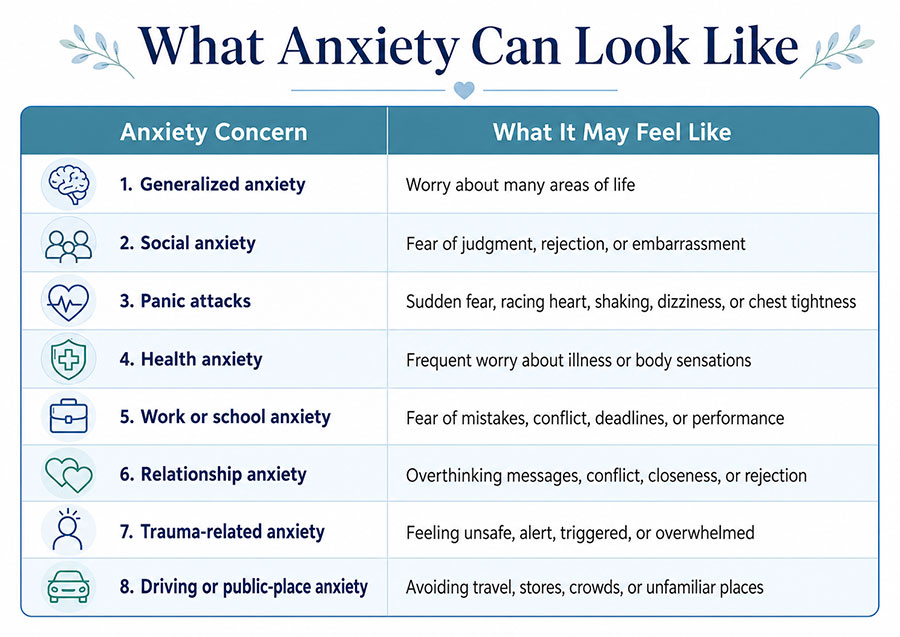
| Anxiety Concern | What It May Feel Like | How Therapy May Help |
|---|---|---|
| Generalized anxiety | Worry about many areas of life | Identify worry patterns and build coping tools |
| Social anxiety | Fear of judgment, rejection, or embarrassment | Build confidence and reduce avoidance |
| Panic attacks | Sudden fear, racing heart, shaking, dizziness, or chest tightness | Understand panic symptoms and practise grounding |
| Health anxiety | Frequent worry about illness or body sensations | Manage uncertainty and reduce reassurance-seeking |
| Work or school anxiety | Fear of mistakes, conflict, deadlines, or performance | Improve stress management and boundaries |
| Relationship anxiety | Overthinking messages, conflict, closeness, or rejection | Build emotional awareness and communication skills |
| Trauma-related anxiety | Feeling unsafe, alert, triggered, or overwhelmed | Develop grounding and trauma-informed coping tools |
| Driving or public-place anxiety | Avoiding travel, stores, crowds, or unfamiliar places | Use gradual exposure and confidence-building strategies |
Anxiety therapy helps you understand your specific pattern instead of treating anxiety as one general problem.
What Happens in the First Anxiety Therapy Session?
The first session is usually focused on understanding what anxiety has been like for you.
You do not need to explain everything perfectly.
You can begin with what feels hardest right now.
An anxiety therapist may ask about:
- When anxiety started to feel difficult to manage
- What situations make anxiety worse
- What happens in your body when anxiety rises
- Whether panic attacks, avoidance, or sleep problems are happening
- How anxiety affects work, school, relationships, parenting, or daily routines
- Whether depression, trauma, anger, grief, or substance use may also be involved
- What you have tried before
- What you would like to feel differently over time
The first session is not about judging you.
It is about understanding the pattern clearly enough to begin building support around it.
Anxiety Often Grows Through Avoidance
Avoidance can feel helpful in the short term.
If something makes you anxious, avoiding it may bring relief.
But over time, avoidance can make anxiety stronger.
For example:
| Avoided Situation | Short-Term Relief | Long-Term Effect |
|---|---|---|
| Skipping social plans | Less immediate discomfort | Social situations may feel harder next time |
| Avoiding difficult conversations | Less conflict in the moment | Anxiety and resentment may build |
| Not driving certain routes | Feeling safer temporarily | Driving confidence may shrink |
| Delaying appointments | Avoiding worry for now | Fear may increase over time |
| Avoiding work tasks | Less pressure today | Stress may become larger later |
Therapy can help you approach feared situations gradually and safely.
The goal is not to push too quickly.
The goal is to build confidence step by step.
How Anxiety Therapy Can Help
Anxiety therapy is practical.
It can help you understand anxiety, manage symptoms, and respond differently when anxious thoughts or feelings appear.
| Area of Support | How Therapy May Help |
|---|---|
| Trigger awareness | Identify what activates anxiety |
| Body regulation | Learn breathing, grounding, and calming strategies |
| Thought patterns | Notice and challenge fear-based thinking |
| Panic support | Understand physical symptoms and reduce fear of panic |
| Avoidance | Take manageable steps toward situations you have been avoiding |
| Sleep | Reduce nighttime worry and build steadier routines |
| Communication | Express needs and boundaries more clearly |
| Self-confidence | Build trust in your ability to handle discomfort |
| Emotional awareness | Understand what anxiety may be trying to protect you from |
CAMH notes that cognitive behavioural therapy has the strongest evidence base as psychotherapy for anxiety disorders and is considered a first-line psychotherapy option.
A Simple Anxiety Check-In
This is not a diagnosis.
It is a private way to consider whether Oshawa anxiety therapy may be helpful.
| Area | Ask Yourself |
|---|---|
| Worry | Do I worry more than I want to, even when I know it may not help? |
| Control | Is it hard to stop anxious thoughts once they begin? |
| Body | Do I often feel tense, restless, shaky, nauseous, or on edge? |
| Sleep | Does anxiety make it hard to fall asleep or stay asleep? |
| Avoidance | Am I avoiding people, places, tasks, or conversations because of fear? |
| Focus | Is anxiety affecting my ability to work, study, parent, or make decisions? |
| Relationships | Do I overthink conflict, rejection, judgment, or closeness? |
| Daily life | Is anxiety making life feel smaller than I want it to feel? |
If several of these feel familiar, counselling may be a helpful next step.
You do not need to wait until anxiety becomes unmanageable.
Can Anxiety Therapy Help With Panic Attacks?
Yes.
Panic attacks can feel frightening.
They may involve a racing heart, shortness of breath, shaking, dizziness, sweating, nausea, chest tightness, or feeling like something terrible is about to happen.
Even when panic attacks are not medically dangerous, they can feel very real and overwhelming in the moment.
Therapy can help by teaching you to:
✓ Understand what panic is
✓ Recognize early signs
✓ Reduce fear of body sensations
✓ Use grounding tools during panic
✓ Identify situations that increase panic
✓ Build a plan for responding when panic appears
Panic therapy is not about telling yourself to “calm down.”
It is about learning what is happening in your nervous system and practising ways to respond differently.
Can Anxiety Therapy Help With Overthinking?
Yes.
Overthinking is one of the most common reasons people seek anxiety counselling.
You may replay conversations.
Imagine worst-case outcomes.
Second-guess decisions.
Worry about what people think.
Prepare for problems that may never happen.
Therapy can help you identify patterns such as:
- Catastrophizing
- Mind-reading
- All-or-nothing thinking
- Reassurance-seeking
- Perfectionism
- Fear of uncertainty
- Self-criticism
- Replaying past mistakes
The goal is not to never think ahead.
The goal is to stop anxious thoughts from controlling your time, energy, and choices.
Anxiety, Depression, Trauma, and Anger Can Overlap
Anxiety often connects with other emotional challenges.
Someone may feel anxious and depressed at the same time.
Someone may become irritable because they are constantly overwhelmed.
Someone may feel anxious after trauma because their body is still scanning for danger.
Someone may use alcohol, cannabis, or other substances to temporarily reduce anxious feelings.
Anxiety therapy may also support people experiencing:
✓ Depression or low mood
✓ Trauma and PTSD symptoms
✓ Anger and irritability
✓ Addiction recovery concerns
✓ Relationship stress
✓ Separation or divorce
✓ Domestic violence concerns
✓ Grief and loss
✓ Burnout and workplace pressure
Therapy can help you understand whether anxiety is the main concern or part of a larger emotional pattern.
What Tools Might You Learn in Anxiety Therapy?
Different therapists use different approaches, but anxiety counselling often includes practical tools you can use between sessions.
| Tool | How It May Help |
|---|---|
| Grounding exercises | Bring attention back to the present moment |
| Breathing techniques | Reduce physical intensity in the body |
| Thought tracking | Identify repeated worry patterns |
| Worry scheduling | Create limits around rumination |
| Gradual exposure | Build confidence around avoided situations |
| Boundary setting | Reduce stress connected to people or obligations |
| Sleep routines | Support rest and reduce nighttime worry |
| Self-compassion | Reduce harsh self-talk and fear of failure |
CAMH’s anxiety treatment guidance notes that when symptoms are mild to moderate and there is no crisis, initial support may include psychoeducation, healthy lifestyle choices around diet, sleep, and exercise, self-help resources, and CBT where available.
What Progress Can Look Like
Progress in anxiety therapy is often gradual.
It may not mean anxiety disappears completely.
Instead, progress may look like:
- Sleeping better
- Having fewer panic episodes
- Avoiding fewer situations
- Recovering faster after anxiety spikes
- Feeling more comfortable setting boundaries
- Overthinking less often
- Feeling more present in relationships
- Making decisions with less fear
- Trusting yourself more
- Feeling able to handle discomfort without shutting down
Small changes matter.
They can create more freedom over time.
Is Online Anxiety Therapy Available in Oshawa?
Many Ontario counsellors offer secure virtual counselling.
Online anxiety therapy may be helpful if you live in Oshawa and prefer support from home, need flexibility, or feel anxious about attending an appointment in person.
Virtual sessions can still focus on practical tools, anxiety triggers, panic support, overthinking, avoidance, relationship stress, and emotional regulation.
The most important factor is whether the setting feels private, safe, and comfortable enough for you to speak honestly.
When Anxiety May Need Urgent Support
Anxiety therapy can be helpful, but it is not an emergency service.
If you are in immediate danger or need urgent medical help, call 9-1-1.
If you are thinking about suicide or are worried about someone else, call or text 9-8-8 in Canada for 24/7 crisis support.
If anxiety symptoms are sudden, severe, medically concerning, or feel different from anything you have experienced before, seek medical support.
Finding an Anxiety Therapist in Oshawa
The right therapist should help you feel respected, understood, and supported.
You should not feel dismissed or rushed.
When looking for anxiety therapy in Oshawa, consider asking:
- Do you have experience supporting anxiety and panic concerns?
- Can you help with overthinking, avoidance, and physical anxiety symptoms?
- What approaches do you use for anxiety therapy?
- Can you support anxiety connected to trauma, depression, anger, or relationship stress?
- Do you offer virtual counselling for Oshawa residents?
- What can I expect in the first few sessions?
You do not need perfect words before reaching out.
You can begin with:
“I feel anxious a lot, and I am not sure how to manage it anymore.”
That is enough.
Final Thoughts
Anxiety therapy may be right for you if anxiety is making life feel smaller, heavier, or harder to manage.
You do not need to be in crisis.
You do not need to have a diagnosis.
You do not need to know exactly what kind of therapy you need.
Anxiety therapy in Oshawa can help you understand your patterns, reduce overthinking and avoidance, manage physical symptoms, and build more confidence in daily life.
Freedom Counselling provides supportive counselling for people navigating anxiety, depression, trauma, anger, addiction recovery, domestic violence concerns, separation, divorce, and other difficult life experiences.
Frequently Asked Questions About Anxiety Therapy in Oshawa
Is anxiety therapy right for me?
Anxiety therapy may be right for you if worry, panic, overthinking, avoidance, sleep problems, physical tension, or fear are affecting your daily life, relationships, work, school, or confidence.
Do I need an anxiety diagnosis to start therapy?
No. You do not need a formal diagnosis to start anxiety therapy. Many people seek counselling because anxiety is becoming difficult to manage, even without a diagnosis.
Can anxiety therapy help with panic attacks?
Yes. Anxiety therapy can help you understand panic symptoms, reduce fear of physical sensations, identify triggers, and practise grounding tools for managing panic attacks.
Can therapy help if I overthink everything?
Yes. Therapy can help you recognize overthinking patterns, challenge fear-based thoughts, reduce rumination, and build healthier ways to respond to uncertainty.
Is online anxiety therapy available in Oshawa?
Many Ontario counsellors offer secure virtual counselling. Online anxiety therapy can be helpful for Oshawa residents who want privacy, flexibility, or support from home.