
Divorce can feel like more than the end of a relationship. Divorce counselling in London can help individuals going through challenging divorces.
It can feel like the end of a future you imagined.
It can change your home, routines, finances, parenting schedule, friendships, identity, and sense of stability.
Even when separation is the right decision, healing can still take time.
Divorce counselling in London gives people a private, supportive space to process what happened, manage difficult emotions, and begin rebuilding life with more clarity.
You do not need to have everything sorted out before seeking support.
You can begin while you are confused.
You can begin while you are grieving.
You can begin while you are angry.
You can begin while you are simply trying to get through the next week.
Quick Answer
Yes, divorce counselling can help you heal.
It can help you process grief, reduce emotional overwhelm, understand relationship patterns, manage anger or anxiety, rebuild confidence, set healthier boundaries, and move forward after separation or divorce.
Divorce counselling is not about pretending the relationship did not matter.
It is about helping you carry the experience differently so it no longer controls your daily life.
For some people, healing means accepting the end of the relationship.
For others, it means learning to co-parent, rebuilding trust, managing conflict, or rediscovering who they are outside the marriage.
What Does Healing After Divorce Mean?
Healing does not mean you never feel sad again.
It does not mean you forget the relationship.
It does not mean you instantly feel ready to date, move, co-parent, or start over.
Healing may mean:
✓ You can think about the relationship without feeling overwhelmed
✓ You stop blaming yourself for everything
✓ You feel more confident making decisions
✓ You can manage contact with your former partner more calmly
✓ You begin rebuilding routines that feel like your own
✓ You feel less anxious about the future
✓ You understand what happened with more clarity
✓ You feel more connected to yourself again
Healing is not one moment.
It is a series of small changes that help you feel more stable, grounded, and hopeful over time.
How Divorce Counselling Can Help
Divorce counselling helps by giving you a structured place to understand what you are feeling and what you need next.
You may be dealing with grief, anger, guilt, fear, loneliness, betrayal, rejection, confusion, or relief.
Sometimes several of those emotions appear in the same day.
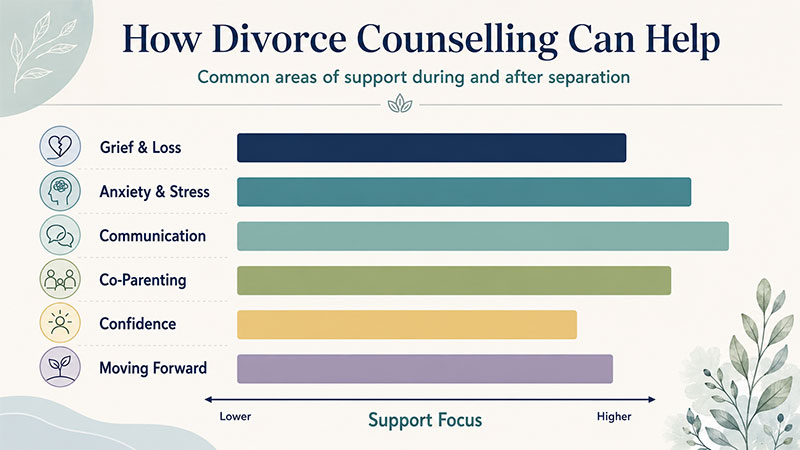
| Area of Healing | What It May Feel Like | How Counselling Can Help |
|---|---|---|
| Grief | Mourning the relationship, family structure, or future you expected | Process the loss without rushing yourself |
| Anxiety | Worrying about money, parenting, housing, dating, or the future | Create grounding tools and practical next steps |
| Anger | Feeling resentful, betrayed, blamed, or unheard | Understand anger and express it more constructively |
| Guilt | Questioning your choices or blaming yourself | Separate responsibility from self-attack |
| Identity | Feeling unsure who you are outside the relationship | Rebuild confidence and personal direction |
| Co-parenting stress | Struggling with communication, schedules, or conflict | Strengthen boundaries and reduce reactive communication |
| Trust issues | Feeling afraid to open up again | Understand relationship patterns and emotional needs |
| Moving forward | Feeling stuck even after the relationship has ended | Build realistic goals and healthier routines |
The goal is not to force you to move on quickly.
The goal is to help you move forward honestly.
When Divorce Counselling in London May Help
There is no perfect time to start counselling.
Some people begin before the separation is final.
Some begin during legal or parenting decisions.
Others wait until months or years later when they realize they still feel stuck.
You may benefit from divorce counselling in London if you notice:
- You feel emotionally overwhelmed by the separation
- You keep replaying what happened
- You feel angry most of the time
- You are struggling to sleep, eat, focus, or function
- You feel anxious about the future
- You feel isolated from friends or family
- You are struggling with co-parenting
- You feel guilty, ashamed, rejected, or abandoned
- You have difficulty trusting people
- You feel like you lost part of yourself
- You want to move forward but do not know how
You do not need to be in crisis to seek help.
Support can be useful as soon as the process starts to feel too heavy to manage alone.
What Happens in a First Divorce Counselling Session?
The first session is usually focused on understanding your situation.
You do not need to explain the entire relationship history.
You can begin with what feels hardest right now.
A divorce counsellor may ask about:
- Where you are in the separation or divorce process
- What emotions feel most difficult
- Whether you are dealing with grief, anger, anxiety, or depression
- How communication with your former partner is going
- Whether children or co-parenting are involved
- What support you currently have
- What you want to feel differently over time
The first session is not about judging your relationship choices.
It is about helping you feel heard, supported, and clearer about what you need next.
Divorce Can Feel Like Grief
Divorce often involves grief.
Even when the relationship was painful, complicated, or unhealthy, there may still be loss.
You may grieve:
✓ The person you thought your partner was
✓ The version of the relationship you hoped for
✓ Family routines and traditions
✓ Time with your children
✓ Shared friends or community
✓ Financial stability
✓ Your home or neighbourhood
✓ The future you imagined
✓ Your sense of identity as a spouse or partner
Grief can show up as sadness.
It can also show up as numbness, anger, anxiety, fatigue, confusion, or difficulty concentrating.
Counselling helps you make space for these emotions without letting them take over every part of your life.
Can Counselling Help If I Still Love My Ex?
Yes. You can still love someone and know the relationship is ending.
You can miss someone and still need distance.
You can feel relief and grief at the same time.
Divorce counselling gives you room to be honest about mixed emotions.
It can help you work through questions such as:
- Why do I still miss someone who hurt me?
- How do I let go of the future I imagined?
- How do I stop hoping they will change?
- How do I accept that the relationship is over?
- How do I move forward without rushing myself?
Healing does not require pretending you never cared.
It requires learning how to care for yourself now.
Can Counselling Help If I Am Angry?
Yes. Anger is common after separation and divorce.
You may feel angry about betrayal, emotional neglect, financial stress, parenting conflict, legal issues, or years of feeling unheard.
Anger is not automatically wrong.
But it can become harmful when it keeps you stuck or affects your wellbeing, communication, parenting, or decision-making.
Counselling can help you:
| Anger Concern | Counselling Support |
|---|---|
| Constant resentment | Identify what is unresolved and what boundaries are needed |
| Reactive communication | Practise slowing down before responding |
| Conflict with an ex-partner | Separate practical issues from emotional triggers |
| Co-parenting frustration | Build calmer, more child-focused communication |
| Anger at yourself | Work through guilt, regret, and self-blame |
| Feeling consumed by the past | Create space for future-focused decisions |
The goal is not to deny anger.
The goal is to understand it and stop it from controlling your next chapter.
Can Divorce Counselling Help With Anxiety?
Yes. Divorce can create major uncertainty.
You may worry about money, children, housing, dating, loneliness, family reactions, legal steps, or what life will look like next.
Anxiety may show up as:
- Racing thoughts
- Panic
- Difficulty sleeping
- Trouble making decisions
- Overthinking messages from your ex
- Fear about being alone
- Worry about children
- Feeling tense or constantly on edge
Counselling can help you slow down the worry cycle.
It can also help you separate what needs action from what is fear about the unknown.
Can Counselling Help With Co-Parenting?
Yes.
Co-parenting after separation can be one of the most stressful parts of divorce.
You may need to communicate with someone you are hurt by.
You may disagree about routines, schedules, school, discipline, money, or new partners.
You may worry about how the changes are affecting your children.
Ontario guidance notes that children going through separation or divorce should feel safe, loved, and supported. It also encourages parents to consider options such as negotiation, collaborative family law, mediation, or arbitration when creating parenting plans.
Divorce therapy can help you:
✓ Respond instead of react
✓ Keep communication clearer and shorter
✓ Set emotional boundaries
✓ Avoid using children as messengers
✓ Manage frustration before conversations
✓ Focus on what children need
✓ Reduce conflict where possible
✓ Support children through change
Counselling does not make co-parenting perfect.
But it can help you show up with more steadiness.
Divorce Counselling Is Not the Same as Legal Advice
Divorce counselling focuses on emotional wellbeing.
It can help with grief, anger, communication, boundaries, stress, confidence, and adjustment.
It does not replace legal advice.
Legal advice may be needed for questions about property, parenting orders, child support, spousal support, divorce applications, or separation agreements.
Family mediation is also different from counselling. Ontario describes family mediation as a way for separating or divorcing people to try to reach agreements about issues such as parenting, support, and property outside of court.
| Type of Support | Main Purpose |
|---|---|
| Divorce counselling | Emotional healing, coping, boundaries, communication, and adjustment |
| Legal advice | Understanding rights, obligations, documents, and court processes |
| Family mediation | Helping separating people work toward practical agreements |
| Co-parenting support | Improving parenting communication and child-focused planning |
| Crisis or domestic violence support | Safety planning, emergency help, shelter referrals, and specialized support |
Many people benefit from more than one type of support during divorce.
What If the Relationship Was Abusive?
If the relationship involved threats, coercive control, stalking, physical violence, sexual abuse, financial control, or intimidation, safety comes first.
In those situations, divorce counselling may be helpful, but it should not be the only support.
You may also need specialized domestic violence services, legal advice, safety planning, shelter support, or crisis resources.
Ontario provides support information for survivors of violence, including crisis counselling, referrals, shelter information, and sexual assault support services.
If you are in immediate danger, call 9-1-1.
If it is safe to do so, use a phone, device, or contact method that the other person cannot access.
A Simple Divorce Healing Check-In
This is not a diagnosis.
It is a private way to consider whether divorce counselling in London may help.
| Area | Ask Yourself |
|---|---|
| Grief | Am I still mourning the relationship, family structure, or future I expected? |
| Anger | Do I feel consumed by resentment, betrayal, or conflict? |
| Anxiety | Am I constantly worried about money, parenting, loneliness, or the future? |
| Identity | Do I feel unsure who I am outside the relationship? |
| Sleep | Has divorce affected my rest, appetite, energy, or concentration? |
| Co-parenting | Do conversations with my ex regularly leave me overwhelmed? |
| Support | Do I feel isolated or unable to talk honestly with people around me? |
| Moving forward | Do I want to heal but feel stuck? |
If several of these feel familiar, counselling may be a helpful next step.
You do not need to wait until you feel completely overwhelmed.
What Tools Can Divorce Counselling Teach?
Divorce counselling can be practical.
It can help you build skills for daily life, not just talk about what happened.
| Tool | How It May Help |
|---|---|
| Grounding strategies | Calm the body during emotional spikes |
| Thought tracking | Identify repeated worry or self-blame patterns |
| Boundary setting | Reduce emotional pressure and conflict |
| Communication planning | Make messages clearer and less reactive |
| Grief processing | Make space for sadness, loss, and acceptance |
| Self-compassion | Reduce shame and harsh self-judgment |
| Routine rebuilding | Create stability after major life change |
| Values work | Clarify what you want your next chapter to reflect |
Small tools can make hard days more manageable.
They can also help you make decisions from a calmer place.
How Long Does Healing After Divorce Take?
There is no fixed timeline.
Some people feel relief quickly once they have support.
Others need more time, especially if the relationship involved betrayal, abuse, long-term conflict, financial stress, or major parenting changes.
Healing may not move in a straight line.
You may feel better one week and deeply sad the next.
That does not mean you are going backwards.
It may mean your mind and body are processing a major life transition.
Counselling can help you keep moving even when progress feels uneven.
Can Divorce Counselling Help Me Trust Again?
Yes. Divorce can affect how you see relationships.
You may wonder whether you ignored warning signs.
You may fear being hurt again.
You may feel unsure how to trust your own judgment.
Counselling can help you explore:
- What you need to feel safe in future relationships
- What patterns you want to understand
- What boundaries you want to protect
- What values matter to you in a partner
- How to rebuild trust in yourself first
- How to avoid rushing into decisions from loneliness or fear
Trust does not need to return all at once.
It can be rebuilt slowly and intentionally.
What If I Feel Like I Failed?
Many people feel like divorce means they failed.
But the end of a relationship does not mean your entire story is a failure.
Relationships are complex.
People change.
Needs change.
Circumstances change.
Sometimes ending a relationship is a painful but necessary step.
Counselling can help you separate:
- What you were responsible for
- What was outside your control
- What you can learn
- What you can release
- What you want to choose differently moving forward
Accountability can be useful.
Self-punishment is not the same thing as healing.
When Immediate Support Is Needed
Divorce can bring intense emotions.
Counselling can help, but it is not an emergency service.
If you are in immediate danger, call 9-1-1.
If you are thinking about suicide or worried about someone else, call or text 9-8-8 in Canada for 24/7 crisis support.
You deserve support before things feel unbearable.
Finding Divorce Counselling in London
The right counsellor should help you feel heard, respected, and supported.
You should not feel rushed, judged, or pressured to make decisions before you are ready.
When looking for divorce counselling in London, consider asking:
- Do you have experience supporting separation and divorce?
- Can you help with grief, anger, anxiety, or depression after divorce?
- Can you support co-parenting stress and communication boundaries?
- Do you provide individual counselling for divorce recovery?
- Do you offer secure virtual counselling for London residents?
- What can I expect in the first few sessions?
You do not need perfect words before reaching out.
You can begin with:
“I am going through a divorce, and I do not feel like myself.”
That is enough.
Final Thoughts
Divorce counselling can help you heal by giving you space to understand what happened, process difficult emotions, rebuild confidence, and move forward with more clarity.
Healing does not mean the relationship never mattered.
It means the end of the relationship no longer defines your entire life.
Divorce counselling in London can support you through grief, anxiety, anger, co-parenting stress, identity changes, and the uncertainty of beginning again.
Freedom Counselling provides supportive counselling for people navigating separation, divorce, trauma, anxiety, depression, anger, addiction recovery, domestic violence concerns, and other difficult life experiences.
Frequently Asked Questions About Divorce Counselling in London
Can divorce counselling help me heal?
Yes. Divorce counselling can help you process grief, anger, anxiety, guilt, identity changes, co-parenting stress, and the emotional impact of separation or divorce.
Do I need counselling if the divorce was my decision?
Yes. Even when divorce is your decision, it can still bring grief, stress, guilt, uncertainty, and major life changes. Counselling can help you move through those emotions with support.
Can divorce counselling help with co-parenting?
Yes. Divorce counselling can help parents manage stress, set boundaries, communicate more clearly, and stay focused on what children need during and after separation.
Is divorce counselling the same as legal advice?
No. Divorce counselling focuses on emotional support, coping, communication, and healing. Legal advice is needed for legal rights, agreements, parenting orders, support, property, and court-related questions.
Is online divorce counselling available in London?
Many Ontario counsellors offer secure virtual counselling. Online divorce counselling can be helpful for London residents who want privacy, flexibility, or support from home.